Subject: Your screws are running low soon
07:43
Good day, your last order was six weeks ago. Your usual items are ready:
 Chipboard screws 4 × 40 mmlastly 10 packs
 Universal wall plug 8 mmlast 5 packs
 Sanding paper K120lastly 2 packs
Our AI detects in your order data when which customer will order again. Exactly at that moment, they receive a newsletter tailored to them: featuring their products or a specialized article on their topic.
Good day, your last order was six weeks ago. Your usual items are ready:
Chipboard screws 4 × 40 mmlastly 10 packsUniversal wall plug 8 mmlast 5 packsSanding paper K120lastly 2 packsYour customers do not buy on impulse, but out of need. A newsletter that reaches everyone at the same time comes at the wrong time for almost everyone.
Your newsletter arrives on Tuesday. Your customer needs a restock in three weeks. By then, the email is forgotten.
Offers for everyone fit no one. Anyone who needs screws won't click on the tool case in the autumn sale.
If the demand is there and you are not, your customer will order from the competition. You often only notice this months later.
Every B2B customer orders at their own pace. Our AI learns this rhythm for every customer and every product and schedules the email right before. Not for everyone on the same day, but for each on their own.
For your customers, this feels like a supplier who thinks ahead.
The reminder arrives before your stock runs out. The practice keeps treating patients, the construction site never grinds to a halt.
Your items in your quantities, ordered with a single click. No searching the catalog, no incorrect spare parts.
Order as needed instead of stocking up. This saves capital and space.
The right accessories for the device, the larger pack for the consumables. Only items that customers with the same needs also buy are suggested. For you, this means: more sales per order.
Those who take work off their customers' hands are not compared with others. They are simply reordered from.
You don't need new software or developers. We'll take care of the rest.
An export from your ERP or shop. Four columns are sufficient for the AI: customer number, item number, date, and quantity.
Our proprietary foundation model already knows the language of ordering from many industries. With your data, we tailor it specifically to your customers.
In your design, with you as the sender. Via your newsletter tool like HubSpot, Brevo, or Mailchimp, or directly through us without your own tool.
Real insight into Swiftron Horizon: HubSpot is connected with a building block.
No license, no setup fee, no minimum contract term. We only earn from the revenue that our emails demonstrably generate additionally: 3% of the proven additional revenue. You don't pay a single cent for customers who would have bought anyway.
In B2B, buyers read the email and order later by phone or directly in the ERP. Click tracking falls short here. That is why we measure directly from your order data, without tracking pixels.
Forecast: The AI predicts the next purchase for all customers.
Control group: 10 to 20% of your customers deliberately do not receive an email. They show what would have been bought anyway.
Swiftron Group: Everyone else will receive their personal email in good time before it is needed.
Billing: Every month we compare both groups in a report. You only pay for the difference.
Our approach is anonymous from the start. The AI does not need names or email addresses to understand when a reorder will occur.
We work with customer numbers, article numbers, dates, and quantities. That is all our AI model needs.
With your newsletter tool, we never see your customers' addresses. Without your own tool, we can send them for you, secured by a data processing agreement (DPA).
Before every dispatch, the recipient's consent is verified. No opt-in, no email.
Our forecasting model is the core of Swiftron and runs in German data centers. The email texts are generated in EU data centers, without any personal data.
You sell to business customers, online or traditionally.
Your customers order consumables again and again.
Your assortment has at least around 100 items.
You have your customers' email addresses, with or without a newsletter tool.
No sales team, no slides. You will speak directly with the people who built the system.
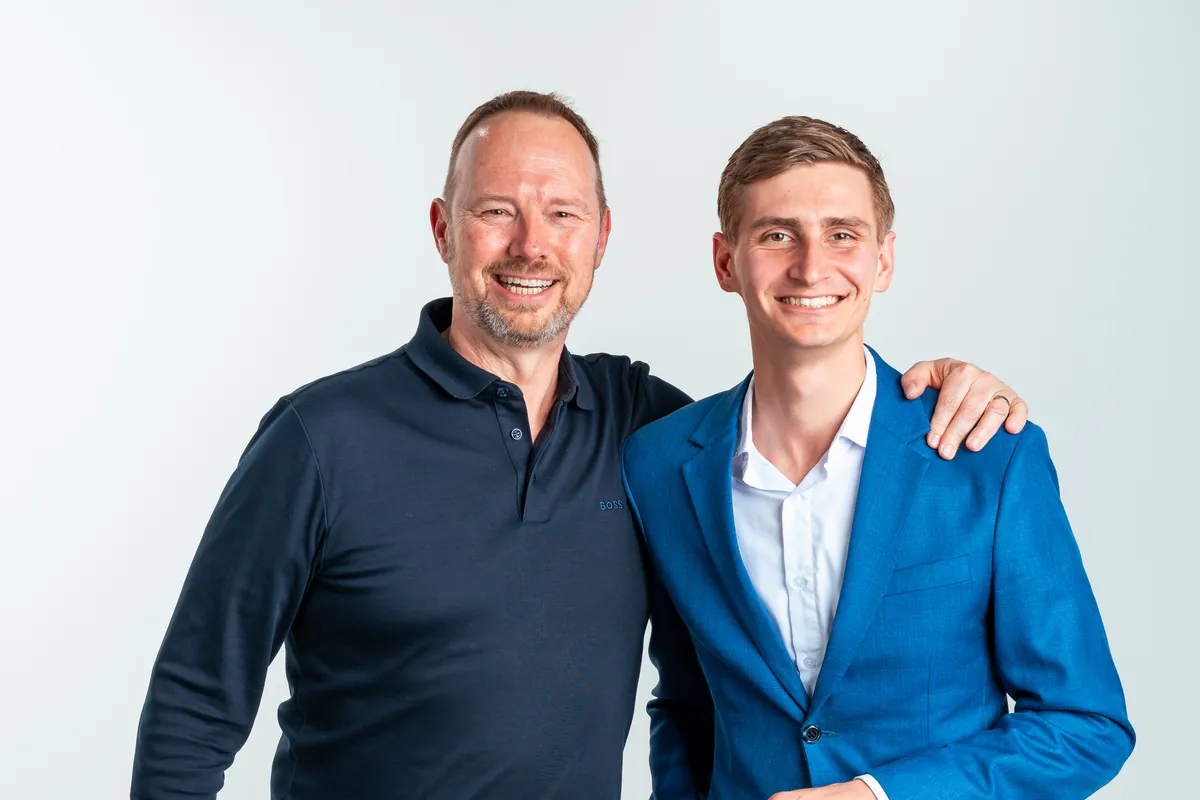
This is what happens during the conversation
We understand your assortment and your customers.
We will show you, using real data from your industry, how accurately our AI model predicts.
We are checking if everything is ready for a quick start. We dislike lengthy ERP projects just as much as you do.
We will tell you honestly if it is worth it for you.
Choose a free 15-minute slot with Pit and Timo.
By clicking, the Google booking calendar will be loaded. Find out more in our privacy policy.
Everything merchants want to know before getting started. Answered briefly and honestly.
HitsNo matching question found.
Is your question not listed here?
Ask us directly. Most things are usually cleared up in 15 minutes.
Book a call with the foundersA B2B newsletter that writes to every customer exactly when they are about to order again. Our AI model detects the rhythm of each individual customer in your order data and predicts when and what they will need next. At that exact moment, they receive a personal email with the matching products. This turns a mass newsletter into an automated reordering service.
A normal newsletter goes out to everyone at the same time with the same content. With us, every customer receives their own email, specifically when an order is due for them, featuring the products they will likely need then. The result: fewer emails, more relevance, and customers who never run out of supplies.
By reminding every customer exactly when their stock is running low. To do this, our AI model calculates each customer's next order date based on your order data and sends an email with the matching products shortly beforehand—one click is all it takes to reorder. All you need is a CSV export, no IT project required.
By the fact that an expected order fails to arrive. Because the model knows the rhythm of each customer, a gap is noticed long before it becomes visible in the monthly evaluation. The customer receives a timely, appropriate email, and if desired, your sales team receives a notification to follow up while the customer can still be retained.
From your previous orders. Our own, pre-trained transformer model knows the typical patterns of repeat purchases: rhythms, seasonality, and products that are bought together. With your data, it gets to know your customers and predicts the next order time and the likely shopping cart for each one.
This depends on the ordering cycle of your industry. For regularly repurchased consumables, the prediction is usually within a few days of the actual order, while for irregular demand, it is closer to two to four weeks. In our initial consultation, we will show you how precise the model is using real data from your industry.
For merchants and manufacturers who sell to business customers and whose customers regularly reorder consumables, such as fastening technology, tools, packaging, office supplies, hygiene, dental and laboratory supplies, or occupational safety. Your assortment should include around 100 items or more, and you should have your customers' email addresses.
After you. The emails appear in your design and with you as the sender, written according to your specifications from the greeting to the tone of voice. The AI only uses real product data from your range. Every email is automatically checked before sending, and you can also approve it yourself if you wish.
Yes, if they match the customer's needs. In addition to reordering, the email can suggest additions (cross-selling) or the next level up (upselling): accessories for the device, a larger package, or the successor model. This is based on what customers with similar purchasing behavior actually buy together. You decide how much space recommendations get in the email.
No. A customer only receives an email if an order is actually pending for them. If they have already ordered beforehand, the scheduled email is automatically stopped. This avoids advertising noise and instead creates a reminder at just the right moment.
Yes. If you already use a newsletter tool like HubSpot, Brevo, or Mailchimp, we will deliver the finished emails there. Recipient lists, consents, and unsubscribes remain with you. If you do not have your own tool, we will handle the sending for you, using your sender address.
No, it relieves them. The regular reminders for repurchasing run automatically. If an important customer does not respond, your sales team receives a notification to follow up upon request. This leaves more time for new customers, large projects, and the conversations where they are truly needed.
An export of your previous orders with four columns: customer number, item number, order date, and quantity. Ideally, two to three years of history. The model does not need names or contact details for this. After that, new orders are added regularly, either via export or automatically via an interface.
Yes. To start, a CSV export is sufficient, which practically any system can generate, whether SAP, Microsoft Dynamics, Shopware, Shopify, or an in-house development. An IT project is not necessary for this. If you wish, we can connect your system directly at a later stage.
As soon as your export is ready, we will adapt our pre-trained model to your customers within a few hours. After that, we will look at the first forecasts and sample emails together and set up the dispatch. With us, there are no implementation projects that take weeks.
Yes. For the forecasts, we only use pseudonymous order data, stored in encrypted form in data centers in Germany. The email texts are generated in EU data centers, without any personal data. Before each dispatch, the recipient's consent is verified. We govern this cooperation in a data processing agreement, and your data will be deleted at any time upon request.
No setup, no license, no minimum term. You pay 3% on the additional revenue that our emails demonstrably generate. For customers who would have bought anyway, you pay nothing.
Via a control group: 10 to 20% of your customers do not receive an email. Every month, we compare what both groups actually ordered. Only the difference counts as additional revenue. This is based on your own order data, not clicks or open rates.
Then you pay nothing. We only earn from proven additional revenue. Without additional revenue, there is no invoice, and since there is no minimum contract term, you can stop at any time.